
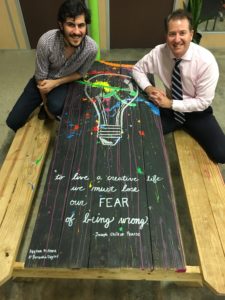
Co-working spaces are on the rise across the country. “We take some of the best ideas out there, we augment them, we evolve them, we renovate them to what works in the Palm Beaches,” said Palm Beach Tech founder, Joe Russo, who started the organization in July 2015.
On any given day, Russo told us we could see any variety of people involved in any level of entrepreneurship. “You see founders, you see business people, you see smart innovative technologists, and you see the people around them: the developers, the designers, the creatives.”
Many co-working spaces are profit-making centers, but Palm Beach Tech is a nonprofit that is here to assist entrepreneurs keep their costs low and have more resources available for their ventures, while also having a shared workplace where they can meet and collaborate with other entrepreneurs.
Palm Beach Tech is sponsored by many organizations, including the Knight Foundation, the City of West Palm Beach, and the Achieve Agency, among others. Members (there are currently 60 or so) also contribute monthly dues that help keep the operation running.
“Nobody gets to a point of success as an entrepreneur unless they have people around them that they can lean on and in return can lean on them,” said Russo. “I think we would all want to work with other good people, as opposed to ourselves alone in a room somewhere that nobody else can even find us. That’s why people go to coffee shops on the weekends. That’s why people go out to be around others to share your life, share your professional experiences with others.”
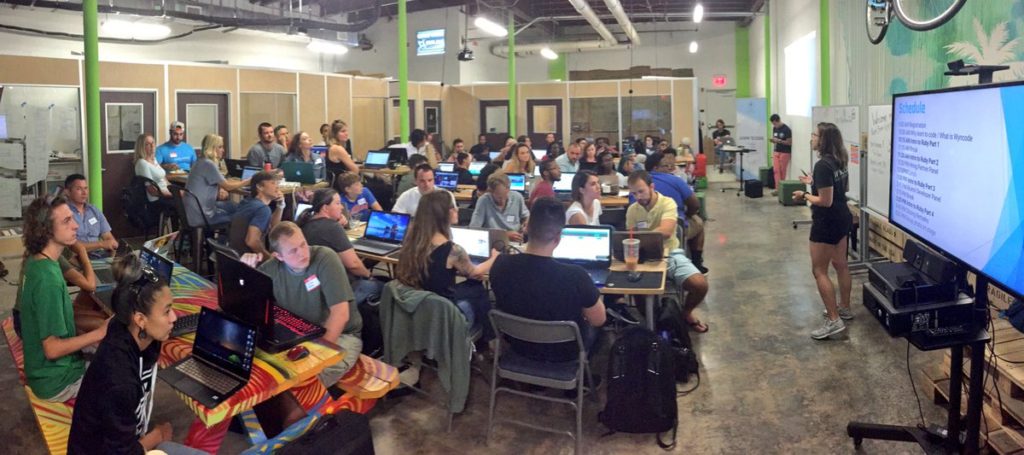
The events they host are purposeful: from workshops that bring people together to work on a technical skill, like JavaScript, or simply a social and professional gathering to hear successful entrepreneurs tell their stories.
As the President — Joe has his hands full, multi-tasking. In addition to keeping the lights on and the coffee pot full, he develops strategic initiatives, including talent development, membership development, attending venture capital conferences, and works with other community partners who are trying to make the Palm Beaches a tech hub.
 Russo encourages other entrepreneurs or those interested in learning what’s going on in the entrepreneurial tech space in Palm Beach County, to come by and check them out. “We are always interested in talk technology and talk about the cool things going on in Palm Beach County, said Russo. “We are better impacting our community every day.”
For more information on becoming involved or learning more about Palm Beach Tech, you can visit their website at: palmbeachtech.org. Also, be sure to tune into Episode 35 of the Agents of Innovation podcast to listen to the full interview with Palm Beach Tech founder Joe Russo, which you can find on iTunes, Stitcher, or Soundcloud. Then, be sure to leave comments below or on the Agents of Innovation Facebook or Twitter pages. And follow the posts on Instagram!
]]>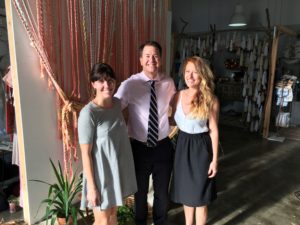
When Danni Mitchell was preparing for her wedding this year, she began looking for a space she could get creative in. She didn’t want to feel trapped by wedding spaces that were confined by what was already there. That might seem a bit out-of-the-box for most people who would like to avoid adding more work to preparing for their wedding day, but not to this graphic designer. So, she found a warehouse. Yes, this bride-to-be thought a warehouse would be the best place for her wedding.
“A warehouse is a beautiful blank canvass to do what you want,” said Mitchell, who was married there this past summer. After spending some time in Brooklyn, she likes the industrial vibe of the space she found. She came across her future wedding space while doing work as a graphic designer for one of her clients, the Warehouse District, a transformational industrial area in West Palm Beach, Florida that is starting to attract artists and entrepreneurs to build their creative projects alongside older, industrial-style businesses and warehouses that have been there for decades.
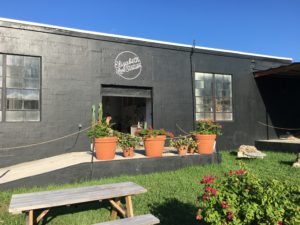
As she started creating ideas for her wedding in the Warehouse District, she and her best friend and colleague Danielle Casey began forming an idea to turn the space into a business. In January 2017, more than six months before the wedding, they turned that space into Elizabeth Avenue Station, which has became a space for artists and vendors to showcase their work. Retail items include pottery, fine art, records, jewelry, and clothing. They currently house 20 vendors in an open floor plan in a 3300 square foot warehouse.
At any given hour of any given day, most of the vendors are not present, but that’s where Danni, Danielle, and their team at Elizabeth Avenue Station come in. They handle any transactions the customers want to make. This allows those vendors, who have other responsibilities such as jobs and families, to not have to be there at every moment. Without Elizabeth Avenue Station, many of these vendors simply sold their products through e-commerce sites online. This allows them to continue to do that, but also hav a place to showcase their work product.
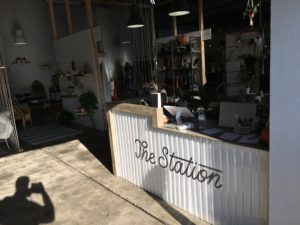
However, most of the vendors and artists are present when Elizabeth Avenue Station hosts events. They do multiple events per month, but their one “big event” each month includes pop-up retailers (in addition to the 20 inside) who set up outside, along with live music and food vendors. On November 18, 2017, they held their first Station Music Festival, which included five live acts played throughout the late afternoon and evening. In addition, every other Thursday features an open-mic night as well as free sunset yoga sessions, which they hope to soon do every Thursday starting in 2018.
One commentator who heard their story called them “accidental entrepreneurs” in the sense that they didn’t first envision the place as a business. It just sort of came to them as they were pursuing their passion through other ways, including their joint Gather and Seek graphic design business. Now they have established a gathering place for creatives and their customers.
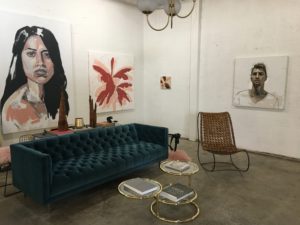
“We are all creative in different ways,” said Danielle Casey. “There is the person who actually hand makes ceramic pieces, and then there’s the person that actually curates the right pieces that maybe they didn’t have the eye to make, but they had the eye to curate it.”
“The culture that appreciates the creativity – I think that’s what we’re trying to attract,” adds Danni Mitchell. “A lot of our consumers have a creative mindset … they want to be involved in the atmosphere and the magic that happens here … the common thread is creativity and community.”
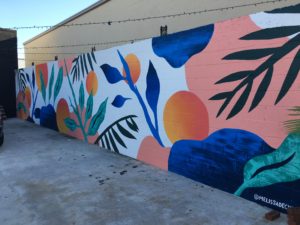
While Elizabeth Avenue Station is a little bit off the beaten path in an industrial area now known as the Warehouse District, there is a vibrancy to the place that is part of a renewing this area and turning it into a place of beauty. The creativeness of Danni Mitchell and Danielle Casey are certainly making this warehouse more than a beautiful blank canvass. It’s now full and alive and bringing more people into a part of town that may have otherwise been overlooked. Creativity and community: it’s a beautiful thing that these “accidental entrepreneurs” have established at Elizabeth Avenue Station.
 To learn more, visit thestationwpb.com — and be sure to tune into Episode 34 of the Agents of Innovation podcast to listen to the full interview with Danni and Danielle, which you can find on iTunes, Stitcher, or Soundcloud. Then, be sure to leave comments below or on the Agents of Innovation Facebook or Twitter pages. And follow the posts on Instagram!
*** Review the podcast on iTunes and let us know! We will then give you a thank you shout out on a future episode of the Agents of Innovation podcast.
]]> Our nation’s veterans are made up of individuals of all walks of life, but they are a special group of people. They put their lives on the line to protect our freedoms. As we celebrate Veterans Day this month, Episode 33 of the Agents of Innovation podcast pays tribute to our veterans by featuring an interview with Rory Diamond, CEO of K9s For Warriors.
K9s For Warriors is the nation’s largest provider of service dogs to military veterans suffering from Post-traumatic Stress Disability (PTSD), traumatic brain injury and/or military sexual trauma as a result of military service post-9/11. The organization was founded in 2011 by Shari Duval. Her son had faced difficulty readjusting to society after two tours in Iraq. However, she noticed a difference in him after he obtained a service dog. She decided to start helping find service dogs for other veterans which led to the formation of K9s For Warriors.
Rory Diamond came on as CEO just three years ago. He has been a litagator for two international law firms, a federal prosector for the U.S. Department of Justice, and has served in the administration of California Governor Arnold Schwarzenegger and in the White House under President George W. Bush. While at the McGuireWoods law firm in Jacksonville, he took on K9s for Warriors as a pro bono client. Then, one day just over three years ago, K9s For Warriors asked him if he would consider coming on as their CEO. “It took me about a half a second to say yes,” Diamond recalls.
While a practicing lawyer, Rory was new to managing staff. Three years ago, he was one of 16 employees when he joined K9s For Warriors as their CEO. Today, the organization has 81 employees and has helped over 331 veterans from 44 states and 216 cities. They’ve also rescued more than 600 dogs.
“In an ideal world, K9s For Warriors wouldn’t exist,” said Diamond. “Our warriors are going and serving multiple tours in Iraq and Afghanistan and they’re coming back and they are not integrating very well,” he says. “PTSD is real, and for the warriors we serve, it is debilitating.”
Rory points out that every day, more than 20 veterans commit suicide and PTSD is a huge driver of that. “The Department of Veterans Affairs has 3 solutions for our PTSD crisis: it’s pills, pills, and more pills,” said Diamond. While that may work for some, it doesn’t work for most. That’s where the service dogs come in.
“There’s something magical about a dog and how they can get a warrior back out into the world again,” says Diamond.
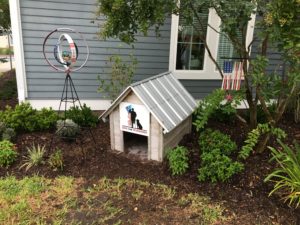 The majority of dogs K9s for Warriors uses are rescue dogs. They are typically more mellow, non-reactive to loud noises, and not food-aggressive. They also share something with the warrior they are paired with: both have experienced trauma. “They talk to each other about it,” says Diamond.
K9s for Warriors used to have a waiting list of 22 months. Thanks to the doubling of their facilities over the past year, today that waiting list is down to one year and they are constantly working to find more dogs, open more facilities, and assist other people and organizations who want to help veterans so that more are treated quicker. The K9s For Warriors headquarters in Ponte Vedra, Florida can house 12 veterans at a time, who then live on-site for three weeks. On the second day, they get their dog. As Rory explains it: “It’s a magical moment.”
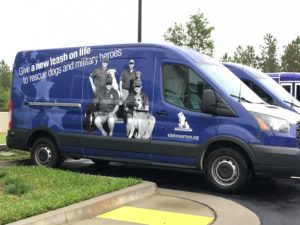
During the next three weeks, the warrior and the dog go through training together. They go to restaurants, stores, and the beach. Their final test: they visit Costco, the Jacksonville Zoo, and St. Augustine. Once they pass certification, the warriors return back to their homes across the country to live with their dogs. Considering the lifespan of a dog, K9s For Warriors guarantees these warriors a dog for life. Some may go through as many as four or five dogs, but most just want one. It’s that bond between the warrior and the dog that changes things for both of them, and reduces the symptoms of PTSD for the warrior.
On Episode 33 of the Agents of Innovation podcast, Rory references a study that has come out since we sat down for the interview (in July). One of the scientific findings this study found is that the cortisol levels in the brain return to normal for the warriors with dogs. As Diamond claims, this is “proof service dogs can change the physiology of the brain for someone with PTSD.”
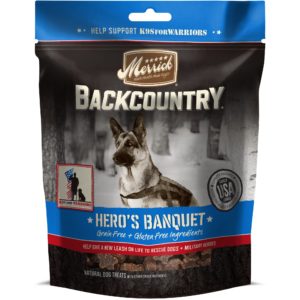
Compared to the behemoth of the Department of Veterans of Affairs, K9s For Warriors is a nonprofit organization that has limited resources and to-date has only accepted funding from individuals, private foundations, and corporate sponsorships. Yet, it is proving to be engaging in a successful experiment that is changing the way we treat our nation’s veterans and some in the halls of Congress are taking notice.
To learn more, visit K9sforwarriors.org — and be sure to tune into Episode 33 of the Agents of Innovation podcast to listen to the full interview with their CEO, Rory Diamond, which you can find on iTunes, Stitcher, or Soundcloud. Then, be sure to leave comments below or on the Agents of Innovation Facebook or Twitter pages. And follow the posts on Instagram!
*** Review the podcast on iTunes and let us know! We will then give you a thank you shout out on a future episode of the Agents of Innovation podcast.
]]>
Nick Gill is a man of many places but also many talents. He was born in Washington, DC, raised in Fairhope, Alabama, and is currently living in Nashville, Tennessee. After high school, he didn’t take the usual route to college. Instead, he pursued his talents as a musician and went to Nashville.
He went down Nashville’s famous “Music Row” and gave his music to as many people as possible. Between 2006 and 20012, he released five albums. His latest, Waves Are Only Water, scored him some notoriety and many gigs across the South.
He then decided it was time to get back to school. He moved to Auburn and attended community college before moving back to Nashville to pursue degrees in business and marketing at Lipscomb University. He graduated this past May and is now keeping his options open while he keeps his dreams alive.
In addition to writing and playing music, Nick has also dabbled in acting and music production for other emerging artists. In fact, today he is putting more of his time and energy into those pursuits.
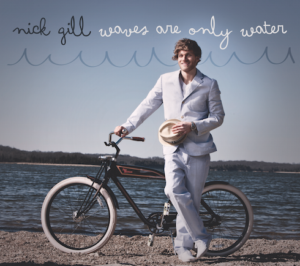
On the acting side, Nick has been an extra in big films like Hunger Games: Mocking Jay Part 2. “I love being a small part in a big film,” says Gill. He has also appeared in television commercials and had some lines in television shows, including a recent gig he had on the show Nashville.
He typically does a lot of self-recording auditions, where he records an audition at home and sends it on to casting agencies or film companies. He has a booking agent that helps him identify potential roles. If a few bigger ones were to come through, a move to Los Angeles, or even Atlanta, to pursue an acting career, is something he is also considering.
With today’s technology making music production more accessible for the average person, Nick also uses that opportunity – in his house – to work with other artists. “I love the avenue that music production has opened up for me. I can work on other people’s projects,” said Gill. “I love being… the support system. The spotlight is fine, but I just like exploring within Logic, getting to discover new sounds, and making samples. It’s just really interesting to me.”
Of course, the music and acting industry aren’t easy arenas to make it in. Sometimes you just got to pay the rent. He has picked up jobs waiting tables at restaurants and he is currently taking real estate courses. His dad has been in the real estate industry in DC for a long time and it’s an option he is considering if the music and acting don’t deliver enough food on the table. “The main thing is trying to find a flexible job so that I can also pursue my creative passions as well,” said Gill.

On Episode 32 of the Agents of Innovation podcast, Nick allowed us to play his song, “When I Worship You.” While most of his music is not worship music or even “Christian music,” he said that he just writes what he feels. “Whatever comes out, comes out, as far as singing or writing. I’m a Christian. If I have something on my mind or something that I feel needs to be expressed, it’s going to come out,” said Gill. “I don’t like to be put in a box. I just like to write and if I like the song, I’ll put it out.”
Nick Gill has lots of paths he could take, but he’s keeping all the options open. “Whatever it is you want to do, just go for it, but be realistic,” he says. “You really have to love it – whatever your passion and gift is. You really have to go for it, but be realistic and be humble.”
To learn more about Nick or follow his current projects, visit: nickgillmusic.com or check out his acting roles on IMDB.com. But first, be sure to tune into Episode 32 of the Agents of Innovation podcast, which you can find on iTunes, Stitcher, or Soundcloud. Then, be sure to leave comments below or on the Agents of Innovation Facebook or Twitter pages. And follow the posts on Instagram!
*** Review the podcast on iTunes and let us know! We will then give you a thank you shout out on a future episode of the Agents of Innovation podcast.
]]>
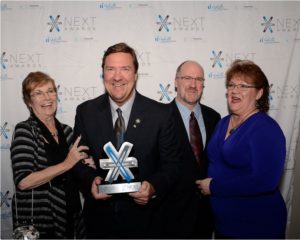 Mark Cleveland is what some might call a serial entrepreneur, but that isn’t entirely accurate. He’s actually a “parallel entrepreneur.” A serial entrepreneur goes from one thing to the next, but a parallel entrepreneur isn’t doing just one thing at a time. After interviewing Mark on the Agents of Innovation podcast, it’s easy to tell why he earned the Next Award for Entrepreneur of the Year in Nashville in 2014, presented by the Nashville Chamber of Commerce and the Entrepreneur Center of Nashville. In addition, his company Swiftwick was honored in 2014 with the “Best in Business” award, given by the Nashville Business Journal.
After attending the University of Oregon (he didn’t finish — and is now back earning a degree at Lipscomb University in Nashville), Mark started his own satellite communications and services business – putting satellite dishes in people’s backyards. While continuing in that effort, only three years later, he started a software development company, managing these two companies at the same time. He later sold them both and went on to his next venture.

Mark was recruited to Nashville to become President of a company that does business process outsourcing for America’s largest fleets (mostly trucking companies) – billing, payroll processing, invoicing, turning compliance documents into digitized images, and then expediting that information back out to the fleets in the most efficient way possible; after five years of doing this, he sold that business with some of his partners. It was eventually bought by Xerox, who still operates it today.
In January 2007, he started a company called Switfwick, which includes a very focused effort on manufacturing in the United States. “I believed after five or six years of outsourcing – and being in that business – that I needed to see if I could enter the manufacturing sector, and use all my skills, and challenge my experiences, to construct and build something in the United States that was world-class; and that became Swiftwick socks.” This brand includes medical compression socks, which improves circulation, prevents blood clots, and is now used by many professional athletes. He retired from being CEO in 2014, but today he is still an investor-owner of Swiftwick.
“I like the idea of starting companies and building companies and I have about a seven-year clock,” said Cleveland. “For all of your listeners who think entrepreneurship and success happens overnight, it’s absolutely true. It just takes about five years to get there overnight.”
 While still CEO at Swiftwick, Mark decided to lead another company; he acquired Hobby Lobby (not the one you’re thinking of!) This Hobby Lobby did radio-controlled airplanes and other high quality radio-controlled hobby products, but it also had the same name as another company more well-known today.
“I bought the company with an appreciation that we were sharing the Hobby Lobby brand name,” he said. “For a long time both companies could say we weren’t interfering with one another.” Mark Cleveland’s Hobby Lobby had the first use and the first trademark. Over time, as the other Hobby Lobby brand continued to grow, and expand out of Oklahoma, across the country, and with 19 stores in Tennessee, there started to become brand confusion, especially when social and economic topics consumed Hobby Lobby’s public images, including a lawsuit against the federal government over compliance with certain facets of the Affordable Care Act.
Cleveland decided to sell the Hobby Lobby brand name and trademark to the other Hobby Lobby and turned his company’s name into Hobby Express, of which he maintains ownership and is still active with. “I have a tough time selling things that I’ve invested this much of my energy into.”

Recently, Cleveland launched a new company called Hytch. It is an app that pairs people going in the same direction. Whenever you carpool or use public transportation, you get points. Those points eventually turn into cash. Essentially, Hytch pays users for sharing a ride.
“We are defending clean air and defeating traffic using technology that’s available today – and incentives, in order to try to get more people to share the ride.”
He believes companies and governments should be involved in rewarding people for sharing a ride since it directly reduces traffic congestion and carbon emissions and keeps the air cleaner. Hytch is a way they can track that use. Hytch pays its users for sharing rides. The app just launched and it can be downloaded on any smart phone device or by going to Hytch.me. And it’s already receiving awards, including the 2016 Nashville Area Metropolitan Planning Organization Innovation Award
Another current project Mark is involved with is the building of a hotel in downtown Nashville. It is called the Stanza Hotel, a 100-bed hotel, with no parking spaces – you’ll be required to park elsewhere or use a shared ride service like Uber or Lyft.
“It’s going to be an exciting piece of architecture,” claims Cleveland. He will be marketing the hotel to be leased floor-by-floor. “I’m trying to provide the lowest cost group experience within walking distance of downtown Nashville.”

“Sometimes the constraints of what you’re looking at are what drive your thinking process into: what can I do that’s 12 stories tall; I can’t park a single car on the property because I’m consuming the entire property by building something on it.” And since consumers can’t park a vehicle there, “it’s got to be a temporary use” type of facility.
“Stanza is a line of poetry, a line of music. We have a 12-story hotel. There’s 12 notes in the musical scale,” said Cleveland. “It’s come together very nicely as a brand. Wherever you see music as the base of a community’s culture – maybe it’s Memphis or New Orleans or Austin – you’ll see a Stanza Hotel.” They plan to start construction on the first Stanza Hotel in Nashville at the the beginning of 2018.
Mark Cleveland’s Advice to Other Entrepreneurs:
Due to his entrepreneurial experiences thus far, Mark Cleveland was able to offer listeners of the Agents of Innovation podcast some advisement from things he’s learned along the way:
“Relationships are lifetime assets: you have to give, you got to help the next generation, the student, the entrepreneur that’s trying to get a foot in. Try to create a part of the ecosystem that you’re involved in.
“Education is super important: I’ve committed myself to be a life-long learner.”
“I try not to succumb to fear. I think that bravery in pursuit of mission is really important. It’s really easy for people to talk you out of a line of thinking because they have a safer perspective or they represent the bulk of the thinking.”
“We are kind of walking around as a society in a daze and some people – entrepreneurs, political leaders, people of faith – have to stand up and decide to change their behavior.”
“I don’t think you can be an entrepreneur and just be all about consumption. You have to be about producing higher quality things. We should be consuming higher quality things and fewer of them.”
“Sticking with your mission and being brave to be different – following the motivation that inspired you in the first place.”
“We entrepreneurs have to encourage each other and come together as a culture and a community to just keep on thinking outside the box and doing things differently.”
“You have to stay on top of technology in every business.”
“Listening to your customer is probably the most important skill you got to have.”
To learn more about Mark or follow his current projects, visit: MarkACleveland.com. But first, be sure to tune into Episode 31 of the Agents of Innovation podcast, which you can find on iTunes, Stitcher, or Soundcloud. Then, be sure to leave comments below or on the Agents of Innovation Facebook or Twitter pages. And follow the posts on Instagram!
]]>
Jordy Searcy came to the American public’s attention in 2014 – at the age of 21 – when he appeared on NBC’s The Voice. But getting there didn’t happen overnight. While growing up in Fairhope, Alabama, he began writing his own music when he was 12 years old and started performing as an artist at the age of 17. He learned most of his vocals from his mother, a voice instructor, who he calls “one of the best vocalists he’s ever heard.”
In late 2013, while a college student at the University of North Alabama, he sent in his audition tape to NBC’s The Voice. After nine rounds and an audition in Nashville, he was one of two hundred people (of 80,000 entries) to be flown to Los Angeles to take part as a contestant. The entire process took nearly a year. He sent in his first audition tape in December 2013 and appeared on two episodes in September and October 2014. While he was ultimately defeated in the battle round, he won over the judges’ hearts. And through the experience, he met many other artists and was mentored by Pharrell Williams and Alicia Keys.
 In that battle round, he said he felt he and Taylor Phelan were able to blow the judges away because of all the time they had to practice. “If you give two artists that are really committed to their craft a month and a half to work on a minute and a half song, every part of it is going to be absolutely dialed in.”
That observation led us to an excellent interview with Jordy Searcy on Episode 30 of the Agents of Innovation podcast.
Now, at the age of 23, Jordy has already produced five albums, but he considers his forthcoming EP this fall to be his first creation of music on a major scale. “Everything else has been practice up to this point,” said Searcy. “Music is a process. You learn how to do things better and better the more you do it.”
“It’s amazing the amount of artists that people are just now starting to hear about and then you go back and resurface their stories, and they’ve really been at it for 10 years or so,” said Searcy. “Sometimes it just takes a lot of time to get the formula right.”
Following his appearance on The Voice in late 2014, Jordy took a hiatus from college and moved to Nashville in 2015. “I tried to go back to school, but I didn’t really have time,” he said. “My [original] goal for going to school was to be working too much to finish school.”
 Before going on The Voice, he considered himself simply a writer and guitar player, but that experience really developed him into more of a singer in the singer/songwriter mold. And fans are now privileged to be able to enjoy some of those great vocals that were first taught to him by his mother.
The Nashville scene has been kind to him and many other artists. While there isn’t the same amount of time to practice and the pressure to churn out a 90-second performance in front of millions of television viewers on The Voice, he says that the Nashville scene provides artists with lots of people to work with. But, he says, you have to put in the time and the hard work.
“The success that you see in Nashville is the people that have been working hard for a long, long time.”
Being in Nashville also allows access to so many other nearby markets. Jordy played 200 shows in 2016 and plans to play 150 shows this year. Almost all of those shows, with the exception of about 10 per year, are outside of Nashville. He is now able to be a full-time artist, making most of his money on the road, while also being sponsored by PreSonus audio electronics and being a part of the Brave Enough Artist Agency where he has a booking agent that helps him get gigs, mostly in college towns.
 Jordy Searcy has been honing his skills as a songwriter for more than a decade. He’s been taught vocals by his mother, and has had experiences of working with major artists while getting exposure to millions of Americans through NBC’s The Voice. He’s at what some might call the intersection of luck and talent.
“I think talent is 15 to 20 percent for sure,” says Searcy. “I think hard work and a little bit of luck is the rest of it.”
To hear our full conversation with Jordy Searcy, listen in to Episode 30 of the Agents of the Innovation podcast on iTunes, Stitcher, or Soundcloud. Then, be sure to leave comments below or on the Agents of Innovation Facebook or Twitter pages. And follow the posts on Instagram!
]]>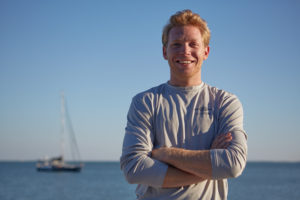
While a student at New College of Florida, Michael Long developed a passion for sailing. He later channeled that passion into developing a nonprofit organization called SailFuture. As a direct alternative to incarceration, SailFuture works with prosecutors, public defenders, and judges to identify youth at risk of being incarcerated and to determine if they are fit for this program. If they are, SailFuture works with the presiding judge to create a placement and accountability agreement that commits the youth to the SailFuture program in lieu of incarceration.
As SailFuture has evolved over the past few years, they now specifically work with “crossover youth,” meaning youth who have involvement with both Florida’s child welfare system and juvenile justice system. These two systems are often at odds with one another. While the child welfare (foster care) system is intended to protect those harmed by society, the juvenile justice system is designed to punish those who have harmed society. These “crossover youth” are mostly foster kids who have committed offenses. According to Michael Long, however, many times, these troubled youth break the law as a coping mechanism to their problems.
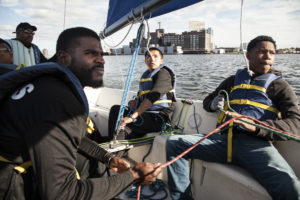
“These kids don’t need to be locked up, but they do need to be held accountable,” said Long. And that’s where SailFuture comes in.
SailFuture is innovative in that it uses sailing as a rehabilitative means for at-risk youth. They learn to build trust, form relationships, realize we are dependent on one another, and ultimately, they break down barriers. By going out on the water, they “learn by doing.”
“Sailing is a therapeutic environment in general – the sea has always been a calming place for many people,” said Long. At the same time, he say that “sailing is also a way to create stress.” When the young men on the boat encounter challenging situations together while out on the water, they quickly find out that everyone on board is dependent on one another.
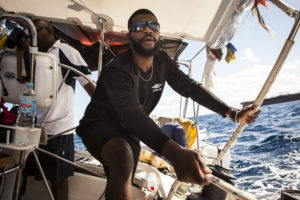 Michael Long may also be uniquely suited to lead this enterprise. Despite the fact he has been so successful by such a young age – he was the captain of his sailing team and student body president at New College of Florida, he served on Florida’s Board of Governors, representing all college students in Florida’s public colleges and university, and he was awarded the prestigious Truman Scholarship – Michael Long had a troubled past as a youth as well. As he told us on the Agents of Innovation podcast, “I was a hell-raiser as a kid. I’m a hell-raiser now.”
SailFuture first started their programs by pairing up college students at New College of Florida as mentors and co-captains with an at-risk local high school youth in the Sarasota, Florida area. In late 2014, they were given an opportunity to expand the program when they received a generous donation of a 65-foot MacGregor sailboat. The vessel was docked in the nation of Turkey, so SailFuture came up with the idea of doing a fundraiser by offering 15 one-week long vacations in the Mediterranean for roughly about 12 people each week in the summer of 2015. They sailed through Turkey, Greece, Italy, Croatia, Spain, Morocco, and the Canary Islands. Finally, over 22 days, they sailed the boat across the Atlantic Ocean to the Virgin Islands, where they offered an additional 13 weeks worth of vacation opportunities in the spring of 2016, before bringing the boat “home” to Florida.
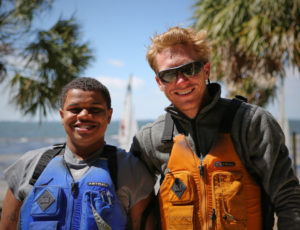 “Everyone should do a long-term sailing journey,” said Long. “It really gives you an enormous amount of time to really reflect on where you’re at in life and what matters and who matters.”
SailFuture recently acquired a waterfront home in St. Petersburg, Florida. As a licensed child welfare agency with the state of Florida, SailFuture houses six young men and performs the functions of a high school, counseling, job training, and 24/7 housing for two years. Long, who is only 25 years old, describes himself as “a glorified dad more than anything.”
For more on what SailFuture is doing with the six young men it is housing for a two-year program, listen in to Episode 29 of the Agents of the Innovation podcast on iTunes, Stitcher, or Soundcloud. Then, be sure to leave comments below or on the Agents of Innovation Facebook or Twitter pages. And follow the posts on Instagram!
]]>

Matt Hires describes himself as an “introvert.” He was homeschooled, so it’s likely he didn’t have a guidance counselor advise him that earning a living playing music in front of live audiences might not be the best career choice.
Born in Orlando, raised in Tampa, Matt’s first introduction to playing music was when his parents first got him piano lessons, but he didn’t take well to the keys. He later picked up the guitar and starting playing for himself. Then his older brother encouraged him to play for others.
After finishing high school, in the years shortly after 9-11, Matt thought he wanted to join the military. He applied to West Point. Because of his homeschooling experience, they required him to go to a military preparatory academy and do some ROTC basic training, which he did. That’s when he realized the military probably wasn’t for him. He moved back to Tampa and enrolled in community college. From there, he formed a band name Brer and toured around Central Florida.
Something strange happened on the way to turning 22 years old. His MySpace page was discovered by Atlantic Records and they signed him. Shortly before, he had proposed to his then-girlfriend and they were married the same week he signed his record contract. He made two full-length albums and five EPs with Atlantic Records. They were catchy. He toured the country with bands like Matchbox20 and Needtobreathe. He played The Rock Boat.
 Two and half years ago, he and his wife moved to Nashville. He made the move at the urging of some Florida friends who had relocated there. So far, it has turned out to be a great change. While Florida is clearly on one corner of the country, Nashville is so much closer to so many more markets that he can play in. As a native-born Floridian, he is also now getting his first taste of the seasons (seasons other than summer apparently do exist!) and it may even be playing a role in the evolution of some of his thinking and writing.
In late 2016, he released his first independent album, American Wilderness with the first track titled, “Fighting a Ghost.” Both are aptly named.
“I feel like it was the first album I put out that I did what I was trying to do all along,” said Hires. “When you’re starting out… you don’t necessarily know what you want your sound to be like or how to communicate exactly what you’re trying to say.” He describes American Wilderness as a “concept album.” He says it is about “life, society, spirituality and different aspects of my American experience.”
His experience with Atlantic Records was great overall. However, as he says, “There were definitely some things that I look back on, if I was deciding all these things on my own, I would have made different choices.”
Today, he is now able to shape his own music and he’s doing it in a world where people consume music radically different than they did at the start of his career a decade ago. When he was first discovered and signed to Atlantic Records, it was “the last hanging on of CDs.” Most consumers now listen to music digitally, often without even purchasing it.
 Like many people, Matt now first discovers music at live shows or through online platforms like Spotify. “Spotify is great for people discovering new music and getting on good playlists,” said Hires. “I usually use Spotify for music discovery and then if I find something I really like, I’ll try to buy it on vinyl.”
It has been nine years since he was first signed by a label, but this introvert says it is only now that “I feel like I’m finally starting to be comfortable in front of audiences.”
Taking the experience of his career to heart, Matt offered advice for younger musicians looking to make a career with their musical talents: “Always be practicing and growing,” he says. “Try to grow and push your boundaries musically and writing. Play shows and work on being as good as you can in front of people.” Matt has been working at that since high school. Now, at the age of 31, he is able to shape his own voice with a new sound and a new venture in the American Wilderness.
To listen to our interview with Matt Hires, tune in to Episode 28 of the Agents of Innovation podcast, available on iTunes, Stitcher, or Soundcloud. Then, be sure to leave comments below or on the Agents of Innovation Facebook or Twitter pages.
]]>
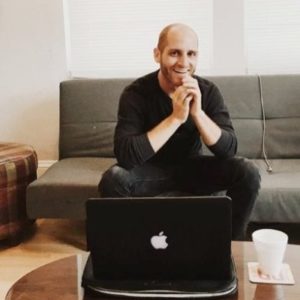
Episode 27 of the Agents of Innovation podcast features an interview with Evan Marcus, co-owner of a Delivery Dudes franchise in midtown Miami. Delivery Dudes is the nation’s premier restaurant food delivery service, delivering for the best local restaurants in your local town. With 46 franchises in 4 states (37 of them in Florida), Delivery Dudes was first started in Delray Beach, Florida by Jason Koss in 2009.
In an on-demand age, with anything in the world delivered to your home, Delivery Dudes is part of the market’s response to consumer demand to pick up and deliver food from your favorite local restaurants. Delivery Dudes charges consumers a delivery fee (sometimes it is waived, depending on the circumstances) and takes a small percentage from the local restaurant.
A week after he graduated from Florida State University in 2014, Evan started delivering for Delivery Dudes in Boca Raton and helped them with the management of their South Beach location. That November, they started signing up restaurants in midtown Miami. And they opened their midtown Miami location in February 2015.

“The cool thing about being a franchise owner (for Delivery Dudes) is that you’re given sort of a rule book and you have to play within that rule book but you also get to custom tailor your own business as long as its within the boundaries of the rule book — and that’s where the creativity comes in, because you have constraints,” says Marcus. The drivers for Delivery Dudes are independent contractors, while the management of each franchise location maintains both full-time and part-time staff who work out of a small office.
“The draw for the restaurant is they don’t need to add any staff … it’s like we’re bringing them extra tables into their restaurant without any extra fee, we’re just taking a percentage off that,” says Marcus.
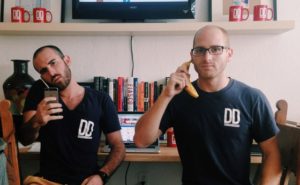
When they started in midtown Miami, there was no one doing the high-end restaurant concept for delivery (unlike major cities like New York and San Francisco). However, since they started, they have seen major national and international companies like E24, Postmates, Uber, and Amazon try to move into the Miami market with a variety of food delivery platforms. So far, no one has been able to compete at the same level as Delivery Dudes. It seems the local guys know more about the local market than the big, national companies have been able to figure out. In addition, many of the local restaurants haven’t added their own delivery drivers because Delivery Dudes has provided such professionalism and efficiency.
In fact, when customers learn they have options to choose from a variety of delivery companies, the local restaurants in midtown Miami often times have customers ask them which is the best delivery service to use – so far, most continue to tell their customers: Delivery Dudes.
“It was nice being able to admit: hey, we’re not Uber. We don’t have the technology they have. We don’t have the money they have to spend on advertising. So, let’s not be them,” says Marcus. “We have a different business model. Let’s stick to working with local, high-end concepts and do what they can’t do.”
“The person at the highest level of UberEats in Miami is not going to be texting the restaurant owners. I am. I’m able to change a menu item in a couple minutes. They are not able to do that. It was liberating, almost, to have them come in and give even greater juxtaposition to why our business model works even better. It was liberating to see this – one of the biggest companies in the world – and say: there are certain things they will never be able to do that we can do by literally just living here.”
To hear more from Evan Marcus about his Delivery Dudes franchise in Miami, tune into Episode 27 of the Agents of Innovation podcast on iTunes, Stitcher, or Soundcloud. Then, be sure to leave comments below or on the Agents of Innovation Facebook or Twitter pages.
]]>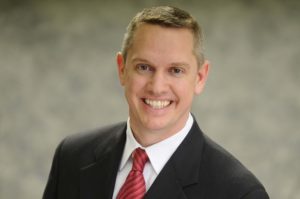
John Crossman is the youngest inductee into the Florida State University Business School Hall of Fame (he was just 43 when they inducted him in 2013). He is the President of Crossman & Company, one of the most successful commercial real estate companies in Florida. He has an honorary degree from the University of Florida and serves on boards of many colleges and universities including the FSU Alumni Association, the FAMU Foundation, Valencia College, and Bethune-Cookman College.
Yet, for all his success and contributions to his community, John graduated with just a 2.9 GPA at FSU. It wasn’t because he was partying or not showing up to class. He went to all his classes, got tutors, ran for the FSU track team, and claims he worked extremely hard as a student to earn that 2.9 GPA. He has an incredible work ethic. He just wasn’t the best learner. It was only in recent years that John found out that he had a learning disability: dyslexia. He must not have ever used that as an excuse to get him to where he is today.
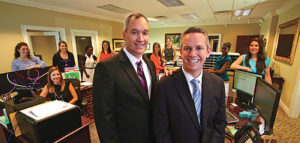
In 2006, John joined his brother’s firm, Crossman and Company, buying a 50% share in the company to become a full partner and serve as President. While his brother Scott handles the operational side of the company, John focuses on business development. Today they have 75 employees, operating 5 offices in 8 states in the Southeast. John’s philosophy that he brings to work everyday is “servant leadership.” He is a servant to his clients, his employees, and to his industry.
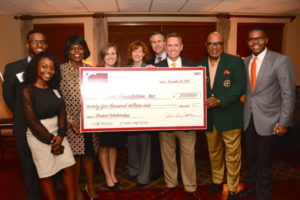
“Leadership is a process of influence,” says Crossman. He first learned this from his father, Kenneth Crossman, a pastor and civil rights leader in Central Florida. John was brought up in a family that valued education and diversity. And his personal philanthropy reflects that well. John has endowed real estate scholarships and programs at Florida A&M University and Bethune-Cookman College, the two leading Historically Black Colleges and Universities (HBCUs) in Florida. This philanthropy allowed him to start opening up a dialogue about how few people in the black community were in the real estate market. In 2014, he was invited to address the Congressional Black Caucus on the subject of real estate and HBCUs.
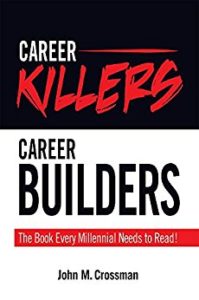
 A husband and father of two beautiful daughters (ages 13 and 11), John also serves as a mentor to many of his employees and other young professionals and college students. He frequently lectures on college campuses (you can watch some of those lectures on his YouTube channel) and recently published a book, Career Killers / Career Builders: The Book Every Millenial Needs to Read! In it, he gives examples of basic things to avoid and specific things and people to seek out. He has proven that a man with a 2.9 GPA, with a hard work ethic, can build a successful career by just doing a few simple things – and working hard at those things each day.
With so many recent examples of people who had it all and messed up, Crossman says he wants to help young people — and those that work with them — to avoid these trappings that have ruined other people’s careers. But he isn’t throwing stones. He shared with us some of his own personal experiences. “What I want to be is vulnerable. I want to be as vulnerable as I can and I try to give that away so that I can help people.”
 He tells us he after some recent professional counseling he also discovered that, “My addiction was work in a way. When something sad would happen to me on a personal level … instead of dealing with it, I just doubled down on my work.” He says many people you see that are successful often use work as an escape instead of dealing with their problems. This is where his advice on having mentors, seeking professional counseling, and finding the right friends and peers to build relationships with can help us deal with our problems and help with a better work-life balance, and ultimately help us build the right career and life for ourselves and our family.
“Balance is very tough,” says Crossman. Despite a full plate of professional and philanthropic involvement, he tries to set firm boundaries as to not overdo it. “If you add anything major to your life you have to take something major out of your life.” He describes this as doing different things in different “seasons of life.” He loves college football, but since his daughters came into his life, he devotes his time to them and has barely seen a college football game since they were born. He also tries to include his wife and daughters in as many of his work functions as possible in order to spend time with them and involve them in his work life.
John Crossman has his priorities right. And his new book will hopefully help thousands of others get theirs right too. Be sure to listen in to our interview with John Crossman on Episode 26 of the Agents of Innovation podcast, which can be found on iTunes, Stitcher, or Soundcloud.
]]>